
Price intelligence
The price of ube powder is not the cost of ube powder.
Two bags labeled "ube powder" can differ so much in composition that their prices cannot be compared per kilogram at all. On one Philippine marketplace, on one day, the same search term returned products from about one hundred sixty-five pesos to about two thousand four hundred pesos per kilogram.
This guide shows what was actually being asked for ube powder on a stated date, why the spread is that wide, and how to compare any two offers on the number that reaches your customer: cost per finished serving.
Every figure below is a dated observation of a public asking price, with its source stated. Listings move daily. Nothing here is a quote, and no figure should be reused without checking its date.
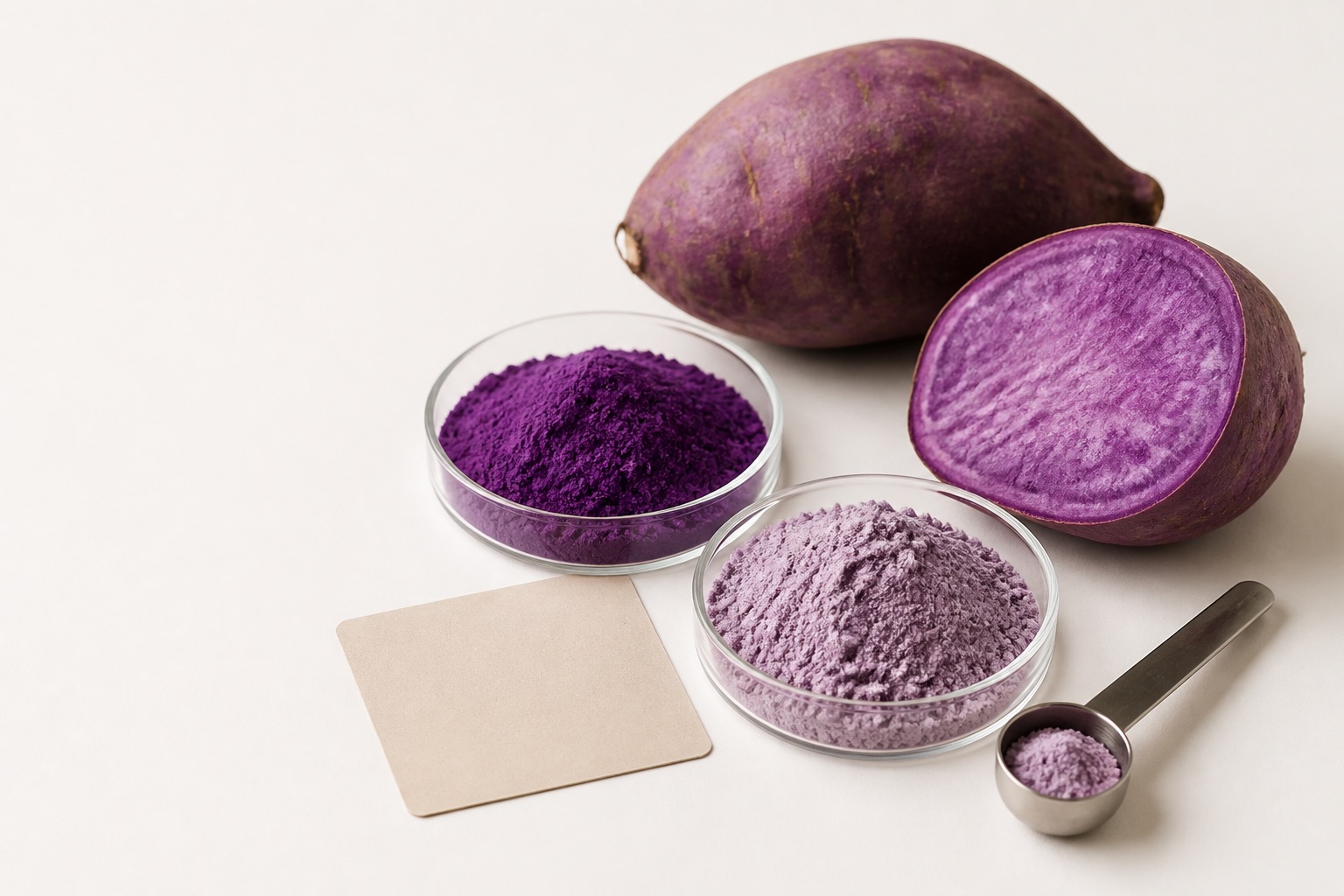
What ube powder was asked to cost
Philippine marketplace observations, captured 2 September 2026.
All rows below were listed on Lazada Philippines under the search "ube powder" on 2 September 2026. Pack sizes are as stated in each listing.
| Product class | Example listing | Pack | Listed price | Per kilogram |
|---|---|---|---|---|
| Milk-shake premix / flavor base | Family's Choice Ube Milk Shake Powder | 1 kg | ₱165 | ₱165 |
| Milk-shake premix / flavor base | inJoy Ube Milk Shake Powder | 1 kg | ₱184 | ₱184 |
| Ube powder, FP grade | Elufa Ube Powder FP | 1 kg | ₱268 | ₱268 |
| Natural ube powder | Cavite seller, "Natural Ube" | 1 kg | ₱350 | ₱350 |
| Branded baking powder | Choco Pinoy CRV Ube Powder | 1 kg | ₱470 | ₱470 |
| Natural ube powder, small pack | Elufa Natural Ube Powder | 115 g | ₱60 | ₱522 |
| 100% pure, premium positioning | Purple Origin, "lab-tested" | 100 g | ₱199 | ₱1,990 |
| 100% pure, bakery grade | Elufa 100% Pure Ube Powder | 200 g | ₱480 | ₱2,400 |
Read the first and last rows again: a fourteen-fold spread under one search term, on one platform, on one day. And the spread is not a brand story — a single brand appears in this table at ₱268 and at ₱2,400 per kilogram, because grade and composition, not the logo, set the price.
What the spread is made of
Composition is the price.
- Ube content. A flavor base or premix can carry sugar, creamer, starch, flavor, and color alongside — or instead of — dehydrated ube. A 100% single-ingredient powder carries only the tuber. They are different products wearing one label.
- Grade and process. Within pure powders, drying method, mesh, and moisture separate bakery grades from premium grades.
- Pack size. Smaller packs cost more per kilogram everywhere. In one US store's own line, captured the same day, price ran from about $251 per kilogram at 3.5 ounces down to about $121 per kilogram at 35 ounces — the large pack costs less than half as much per kilogram.
- Market. The US direct-to-consumer retail observations captured the same day (organic-ube.com, ubiyam.com, myubebae.com, ubesuperfood.com) cluster between roughly $121 and $251 per kilogram — an order of magnitude above Philippine marketplace pricing for comparable search results. That gap is the export story, and it is also why "cheap at source" claims deserve scrutiny.
How to compare two prices that cannot be compared
Divide by servings, not by kilograms.
The only comparison that survives composition differences is cost per finished serving:
- Establish the dose of each candidate that hits your target flavor and color in your actual recipe — not the label's suggestion.
- Count real yield: servings per pack at that dose, after preparation loss and waste.
- Divide pack price by servings. Compare that number, at the quality level your benchmark demands.
A ₱2,400-per-kilogram pure powder used at 8 grams per serving costs about ₱19 of ube per serving. A ₱184-per-kilogram premix used at 30 grams costs about ₱6 — but it also brings its own sugar, creamer, and label implications, so it is answering a different question. Which question you are asking is a format decision before it is a price decision.
From price to supply
A good price you cannot repeat is not a good price.
A screenshot price tells you what one seller asked one day. It does not tell you what the material contains, which lot you would receive, whether the price holds at your volume, or what happens when the listing disappears. For volume purchasing, the price conversation belongs inside a qualified supply path — identity, composition, lot records, destination responsibility, and a reorder standard.
Buyer questions
Frequently asked questions
How should buyers compare price when dosage and yield differ?
Convert both offers to cost per finished serving: the dose that achieves your target result, times real yield after loss, divided into pack price. Per-kilogram comparisons between products of different composition are not meaningful.
Why do ube powder prices vary so much?
Because "ube powder" spans different products: flavor bases and premixes carrying sugar and creamer, carrier-based powders, and single-ingredient pure powders, across grades and pack sizes. On the observation date the Philippine spread ran from ₱165 to ₱2,400 per kilogram.
Is the cheapest powder per kilogram the cheapest to use?
Often not. A low per-kilogram price with a high required dose, added components you must work around, or an unstable supply can cost more per serving — and more per incident — than a higher-priced powder that performs at a low dose, lot after lot.
Do these prices apply to my order?
No. They are dated public asking prices for retail and marketplace packs. A commercial price is quoted against a defined grade, volume, pack, and destination after a Fit Assessment.
Closing CTA
Price the serving, then qualify the path.
Fit before scale
Make the next responsible decision.
Define the application, format, destination, benchmark, volume, timing, and evidence that must be true before commitment rises.